Saturday, October 18, 2014

Installing Apache Hadoop on a Single Node

There are three modes where you can install Hadoop.

  1. Standalone - Everything run on one JVM under one single machine.
  2. Pseudo Distributed - Each run on it's own JVM under one machine. 
  3. Fully Distributed -  Each Service run on it's on machine.
I am using the following Ubuntu, JDK and Hadoop versions:
Hadoop version: hadoop-1.2.1
JDK: openjdk-7-jdk
Ubuntu: Server 14.04 LTS


Configuration and Installation Steps for Pseudo Distributed mode

Generate the public/private RSA key, without a password and save the key file with the default name "id_rsa.pub".
ssh-keygen

Add the generated key to authorized key list
cat ~/.ssh/id_rsa.pub >> ~/.ssh/authorized_keys
For the Fully Distributed mode this key file needs to be send to each node through the "ssh-copy" to avoid password prompts.

Try SSH connect, it shouldn't ask for password
ssh localhost

Install Open JDK
sudo apt-get install openjdk-7-jdk

Check the java version after the installation is completed
java -version

Download the Hadoop
wget http://apache.mirrors.pair.com/hadoop/common/hadoop-1.2.1/hadoop-1.2.1-bin.tar.gz

Unpack the downloaded file
tar -zxvf hadoop-1.2.1-bin.tar.gz

Copy the unpacked files to directory " /usr/local/hadoop".
sudo cp -r hadoop-1.2.1 /usr/local/hadoop

Change the owner to current user
sudo chown mahesh /usr/local/hadoop

Add Hadoop bin directory path to the bashrc file, so you can run Hadoop any directory. 
sudo vim $HOME/.bashrc

Go to the bottom of the file and add the following using a editor such as VIM.
export HADOOP_PREFIX=/usr/local/hadoop
export PATH=$PATH:$HADOOP_PREFIX/bin

Reload the script
exec bash

Check the whether the new path exists in the path variable
$PATH

Change JDK home and enable IP v4, Open following file (I have used the vim editor).
sudo vim /usr/local/hadoop/conf/hadoop-env.sh
Change highlighted lines

# Set Hadoop-specific environment variables here.

# The only required environment variable is JAVA_HOME.  All others are
# optional.  When running a distributed configuration it is best to
# set JAVA_HOME in this file, so that it is correctly defined on
# remote nodes.

# The java implementation to use.  Required.
export JAVA_HOME=/usr/lib/jvm/java-1.7.0-openjdk-amd64
# Extra Java CLASSPATH elements.  Optional.
# export HADOOP_CLASSPATH=

# The maximum amount of heap to use, in MB. Default is 1000.
# export HADOOP_HEAPSIZE=2000

# Extra Java runtime options.  Empty by default.
export HADOOP_OPTS=-Djava.net.preferIPv4Stack=true

# Command specific options appended to HADOOP_OPTS when specified
export HADOOP_NAMENODE_OPTS="-Dcom.sun.management.jmxremote $HADOOP_NAMENODE_OPTS"
export HADOOP_SECONDARYNAMENODE_OPTS="-Dcom.sun.management.jmxremote $HADOOP_SECONDARYNAMENODE_OPTS"


Configure the name node by editing following file.
sudo vim /usr/local/hadoop/conf/core-site.xml

Add the highlighted section
<?xml version="1.0"?>
<?xml-stylesheet type="text/xsl" href="configuration.xsl"?>

<!-- Put site-specific property overrides in this file. -->

<configuration>
<property>
  <name>fs.default.name</name>
  <value>hdfs://mahesh-hd:10001</value>
</property>
<property>
  <name>hadoop.tmp.dir</name>
  <value>/usr/local/hadoop/tmp</value>
</property>
</configuration>

Create the temp directory
sudo mkdir /usr/local/hadoop/tmp

Change the owner to current user
sudo chown mahesh /usr/local/hadoop/tmp

Configure the MapReduce site
sudo vim /usr/local/hadoop/conf/mapred-site.xml

Add the highlighted section:
<?xml version="1.0"?>
<?xml-stylesheet type="text/xsl" href="configuration.xsl"?>

<!-- Put site-specific property overrides in this file. -->

<configuration>
<property>
  <name>mapred.job.tracker</name>
  <value>hdfs://mahesh-hd:10002</value>
</property>
</configuration>

Format the name node
hadoop namenode -format

Following successful message should appear
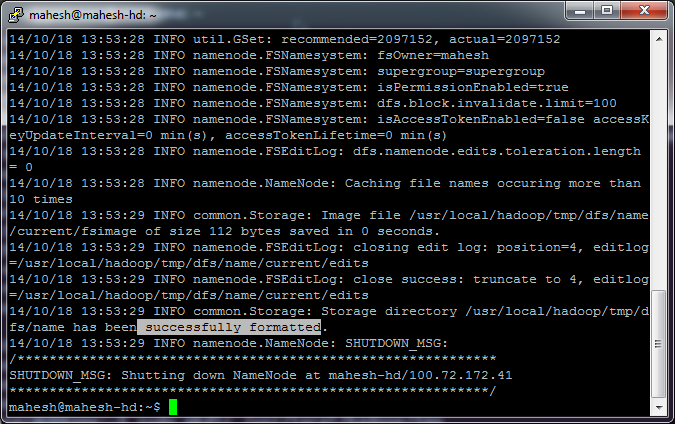

Start all services using:
start-all.sh

Check whether all everything is running using "jps" command


Install Hadoop on Oracle JDK

Download and install Oracle JDK
sudo add-apt-repository ppa:webupd8team/java
sudo apt-get update
sudo apt-get install oracle-java7-installer

Change the hadoop-env.sh file java home directory according to the Oracle JDK path.


A Lion Called Christian

This was  a story about  a lion cub who was bought  by two  Australians (Ace and John) from Harrods department store. They called him Christian.

As the Christian grew bigger they arraigned Christian  to be returned to the wild in Kenya.


Below images shows two unforgettable  Christian's  reunion with the Ace and John. The first reunion was made after almost 2 years after  Christian was returned to the wild.
Second reunion.


Sunday, October 12, 2014

Achieving Rapid Response Times in Large Online Services - Google

When a query comes in there is a whole bunch of sub systems needs to be used in order to generate the information they needs on surface of the page. So they break these large systems down into bunch of sub services, and they need enough computation power on the back end so eventually when they get a query in and hit thousands of server and get all the results back and decide what they gonna show to the user in a pretty short amount of time.


In Google all of these servers run on shared environment, they do not allocate a particular machine for a specific task.

Canary Requests

One of the ways to keeping your serving system safe in the presence of a large fanout system. normally when you take in a query on top of the tree  and send it down to the parents eventually to all the leaves. What happens if all of the sudden the query passing code runs on leaves crash for some reason, due to a weird property of the query never seen before. so all of the sudden you send the query down and it will kill your data center.


To handle this they take a little bit of a latency hit in order to keep the serving system safe. What they do they send the query to just a one leave and if that succeed then they have more confidence that query to gonna trouble sending to all thousand servers.

Backup Request

Request (req 9 ) is sent to particular server and if they do not heard back from that server, the send the same request to a another server.

 Source:https://www.youtube.com/watch?v=1-3Ahy7Fxsc

Wednesday, October 8, 2014

Did George Mallory lead the first successful attempt on the summit of Everest?

It’s a primitive attempt, to do a huge undertaking. He had to rely on human spirit alone not on technology. He just had only his heart and soul.
He was born in 1886. He married Ruth Turner in 1914.

He was invited to Everest expeditions on 1921, 1922 and 1924. He was the only climber who was being on all three expeditions.
it was his last chance to have an attempt on Everest, he knew that  since at the age of 38 he would not have high chance of getting selected to another expedition. He was in for an all-out effort on that final day. He was in the mindset that it’s all or nothing in that day.
He chose Andrew Irvine who was the youngest member of the expedition to join him on final attempt on the summit. Irvine had little experience as a climber but he was skilled with maintaining oxygen equipment’s.

Noel Odell was last person who saw Mallory and Irvine alive, he saw them shortly after mid-day on 8th of June 1924, just a few hundred feet from the summit at 28400 Ft and still going strong for the top. Clouds then rolled in and they were never seen again.

Mallory’s body was found during an expedition in 1999, 75 years after they lost. Surprisingly most of the belongings were well preserved and intact. They found his goggles in his pocket that meant he was climbing down after the sun. So they are assuming from that they are coming down when they fell.  One very significant item was missing the photo of his wife Ruth which he had promised to leave on the summit as ultimate tribute to his love of Ruth. Was the photo missing that the Mallory had reached the summit and placed it there. This really tells that might have fallen during the descent.


Mountaineers believe that Mallory could have climbed even with the standards of mountain climbing during 1924 are very primitive. Just enough of wild man that he might just had a good day and pulled it off. 

Tuesday, October 7, 2014

Why Hadoop is Required

When you have massive loads of data in a RDMS, you usually aggregate raw data and most of the time you move the raw data into a different storage or delete them. So the problem is that when in some point when you want to access that Raw data, there could be two things it very time consuming or not possible.
In some companies have their Raw data in files and they have ETL (Extract, transform, load) tools to aggregate and load them into to a RDMS, This process makes a huge stress on network layer since the data from the file stores has to move into the ETL tool for processing, through the network. Once the data is aggregated it is moved to a achieve location. The archived data retrieval is very slow process as well if some one wants read the raw data again.

So there are three problems:

  1. Cannot access Raw high fidelity data
  2. Computation cannot scale (Since all the data should be taken into the computation engine through the network)
  3. To avoid stress on computation, the old data needs to be archived, and once they are achieved it is an expensive process to access them again.


How the  RDMS process data


Hadoop does not get the data to the computation engine through the network instead it keeps the computation Just Next to the Data.

Each server is processing independently it's local data.


Thursday, July 24, 2014

Overview of Hadoop

Hadoop is an open source cloud computing platform of the Apache Foundation that provides a software programming framework called MapReduce and distributed file system, HDFS (Hadoop Distributed File
System). Hadoop is a Linux based set of tools that uses commodity hardware. Hadoop project was stared by Doug Cutting.The main usage of Hadoop is to store massive amount of data in the HDFS and perform the analytics of the stored data using MapReduce programming model.


Monday, July 21, 2014